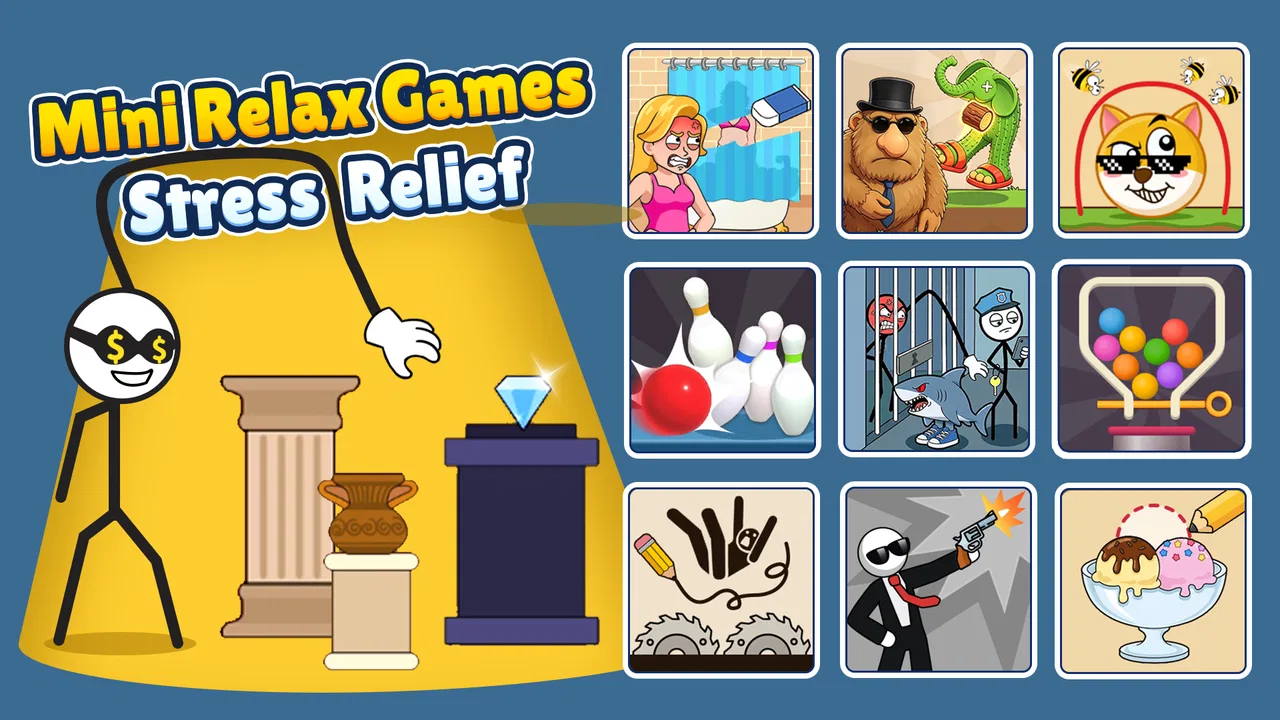
Mini Relax Games Stress Relief
- 4.6
- Rating
- 10.00M
- Installs
- Free
- Price

 Analysis by App-foxy
When I want a short mental break rather than a serious gaming session, I usually look for something that lets me start quickly, understand the controls without a tutorial, and stop without losing a large amount of progress. Mini Relax Games Stress Relief is built around that kind of use. It is a free puzzle game from QY Studio, with a collection of small activities intended for casual play and offline moments. After spending time with it, I see it less as one deep puzzle adventure and more as a pocket-sized rotation of distractions for waiting rooms, commutes, quiet evenings, or those few minutes when my attention needs a reset.
The appeal is easy to understand. The game brings together 25 mini games, so I am not locked into one puzzle style whenever I open it. That variety matters because a relaxing activity can become irritating if it asks for the same kind of concentration every time. Here, I can choose something gentle when I am tired, then switch to a more active challenge when I want my mind occupied. The experience is aimed at Everyone, which also makes it approachable for families and younger players who prefer simple, low-pressure entertainment.
How the short-session design feels in everyday use
The first thing I noticed is that the game makes more sense in small portions than in long, committed sessions. I can open it during a coffee break, play until I feel refreshed, and put it down without treating the session like an appointment. That is a useful distinction from larger puzzle games that encourage me to plan a route, protect a streak, or remember a complicated set of rules. This title works best when I want a quick change of focus, not when I am searching for a single puzzle system to master for weeks.
You May Also Like

 Blood Strike: 2.5 Anniversary
Blood Strike’s Loadouts Turn Every Drop Into a Tactical Gamble
A close look at Blood Strike’s custom loadouts: how fast access to signature weapons reshapes its battle royale rhythm, rewards preparation, and narrows the gap between fights.

 Pandora - Music & Podcasts
Pandora’s Music Is Easy to Start, but Harder to Recover
Pandora’s strength is its low-effort path from a seed to a station. Its weak spot is how much confidence it asks you to place in connection, setup, and quiet recovery.

 8 Ball Pool
 Is Built on Rivalries, Rematches, and Routine
A close look at the rivalries, rematches, shared routines, and unanswered safety questions that turn a quick pool match into a persistent mobile community.

 Samsung Music
’s Quiet Strength Is Playing What You Already Own
Its reach comes less from spectacle than from dependable access to a personal library. That simplicity is both the app’s strongest retention engine and its ceiling.

 AccuWeather: Weather Radar
AccuWeather Review: A Quick, Clear Forecast for Everyday Decisions
For everyday plans, the best forecast is the one you can understand quickly. AccuWeather makes rain timing, radar, and local conditions easy to act on, with a few trade-offs.

 Hill Climb Racing
Why Hill Climb Racing Still Turns Crashes Into One More Run
A tiny car, a bumpy hill and one more upgrade: Hill Climb Racing keeps resurfacing because its simple chaos makes every near-miss feel personal.
More From Our News Desk



A realistic example is a delayed bus or train. Instead of opening a social feed and getting pulled into an endless stream, I can choose a mini game, give it a few minutes of attention, and close the app when the vehicle arrives. The offline play is particularly valuable in that situation because the game can remain useful where a connection is weak or unavailable. I would still treat it as a casual companion rather than a complete travel game library, but that simple availability gives it a practical advantage over online puzzle experiences.
The individual activities also change the emotional texture of a session. If I am mentally worn out, I can avoid anything that feels too demanding and look for a calmer interaction. If I am restless, a more active puzzle can give that energy somewhere to go. This is one of the more important strengths that is easy to miss in a short store description: the variety lets me match the game to my current level of patience instead of forcing my mood to match the game.
What makes the variety useful rather than decorative
A collection of mini games only works if the player is willing to move between them. I found it helpful to treat the app as a menu of short mental exercises instead of expecting every activity to become a favorite. Some will naturally feel more satisfying than others, and that is normal for a package built around variety. The real benefit is the ability to leave an activity that is not fitting the moment without leaving the whole app.
My practical tip is to avoid judging the game after trying only one activity. The collection is the product, not a single puzzle mechanic. I would spend a few minutes sampling several options, then remember which ones feel best for three different situations: low energy, boredom, and a desire for a slightly stronger challenge. That simple approach makes the app feel more personal and reduces the chance that one less appealing mini game determines the entire impression.
There is also a useful trade-off here. Variety lowers the barrier to entry, but it can limit depth. Someone who enjoys learning advanced strategies in one carefully balanced puzzle may find the experience shallow compared with a dedicated logic game. I would choose this app for flexible relaxation, while I would choose a focused puzzle title when I want long-term mastery, detailed progression, or a challenge that steadily builds on one rule set.
Speed expectations and the feel of opening a session
Because the game is designed around short activities, perceived speed matters more than it would in a large adventure game. I expect to get from opening the app to a playable choice without a long preparation process. The compact, casual concept supports that expectation, although the exact feeling will naturally depend on the phone or tablet being used. On a reasonably maintained device, the format should feel most comfortable when I keep my expectations realistic: this is a quick puzzle collection, not a visually demanding production that needs a powerful handset.
The most important speed advantage is not a benchmark number; it is the low mental startup cost. I do not need to remember a story, rebuild a complicated strategy, or study a large interface before making the first move. That makes the app suitable for fragmented time. I can play for a few minutes, leave, and return later without the session feeling like a major commitment.
Offline access strengthens that impression. A game that does not depend on a live connection is easier to use in places where network delays would otherwise interrupt the first moments of play. It also makes it a better fit for airplane mode, underground travel, or a quiet corner with unreliable reception. I would not confuse offline availability with guaranteed instant loading on every device, but it removes one common source of waiting and uncertainty.
There is a small psychological benefit to this format as well. When I know I can finish a short activity before returning to work, I am less likely to feel that playing is stealing the whole break. That makes the game useful for controlled pauses. On the other hand, the same convenience can encourage repeated “just one more” sessions, so I would set a timer if I am using it during study or work.
Where speed matters less than clarity
Fast access is not enough if the controls or instructions create friction. For a relaxation game, I care about understanding what I am meant to do without repeatedly stopping to decode the interface. The mini-game format gives the app a chance to keep each activity approachable, but players should still expect different levels of comfort from different activities. A collection naturally has some unevenness: one puzzle may click immediately, while another may need a few attempts before its rhythm becomes clear.
My advice is to leave an activity quickly when it starts feeling confusing rather than treating that confusion as a personal failure. The point of this game is to provide a menu of manageable distractions. Switching to another option is part of using it well. That mindset preserves the relaxing quality and avoids turning a casual break into an unwanted test of patience.
Heavy-use moments and resource expectations
The app is likely to be most demanding on the player’s attention rather than on the device. Repeatedly moving between mini games, playing for a longer sitting, or returning to it several times in one day changes the experience more than a single short visit. I appreciate that distinction because it helps set realistic expectations: the game is suited to frequent light use, but it may not satisfy someone who wants a substantial session with escalating complexity.
During heavier use, variety can work in two directions. It prevents the immediate boredom that comes from repeating one puzzle, yet it can also make the overall experience feel less cohesive. I may enjoy several activities individually without feeling that they form one complete journey. That is not a flaw if I approach the app as a relaxation toolbox, but it is a limitation if I want a strong sense of progression or a carefully structured campaign.
Resource demands are difficult to judge from the concept alone, so I would avoid expecting the same behavior from every device. The game supports devices running Android 7.0 or later, which places it within reach of many older Android users. Still, an older phone with limited free storage, an aging battery, or a crowded background workload may feel less responsive than a newer device. Closing unused apps and keeping some storage available are sensible steps before blaming the game for sluggishness.
One non-obvious use is to keep the app as a low-pressure alternative for battery-conscious situations, but I would phrase that carefully. Offline play removes network activity as a requirement, yet it does not prove that the game uses very little power. Screen brightness, device age, and how long I play will still matter. If my battery is nearly empty, I would choose a short session and lower brightness rather than assume any offline game is automatically economical.
How to use it without turning relaxation into repetition
For regular use, I get better results by rotating activities deliberately. I might begin with something simple, switch once when my attention settles, and stop before I become bored with the collection. This creates a small routine instead of an endless loop through the same favorite. It also helps me discover whether the app genuinely offers enough variety for my habits or merely gives the impression of variety during the first session.
Another useful workflow is to use it as a transition tool. A short session can mark the end of a work block, the pause between chores, or the beginning of a screen-free evening. In that role, the game is not competing with a full console or a deep mobile puzzle; it is helping me change mental gears. If I need sustained concentration, I would use a dedicated logic game instead. If I need to stop thinking entirely, a quiet audio app or a walk may be better.
Reliability, recovery, and the limits of casual design
Reliability for this kind of game means more than avoiding crashes. I also want the app to let me return to a short activity without making recovery feel like work. Offline play helps because a lost connection should not be the central obstacle to opening a puzzle. The simple structure is another advantage: there are fewer layers of story, competitive systems, or online interaction to manage before I can get back to a small activity.
At the same time, I would not promise that every session will recover identically after a phone call, a memory cleanup, or an operating-system interruption. Any mobile game can be affected by the way a device handles background apps. If I am in the middle of something I care about, I would finish that activity before switching away rather than assuming the exact state will always be preserved. That is a sensible habit with short-session games, especially on older hardware.
The current version is 1.34.20, and the app has reached more than ten million installs with an average rating of 4.6 from around ten thousand ratings. Those figures suggest that the basic concept has found a substantial audience, but they do not replace personal testing. A high rating can reflect accessibility and convenience, while a player seeking deep puzzle design may still find the collection too light. I read the popularity as reassurance that the format is easy to understand, not as proof that it will suit every taste.
There is also a difference between reliability and richness. A stable, simple app can be more useful during a short break than a feature-heavy game that asks me to manage accounts, events, or a large progression system. But simplicity can feel limiting after repeated use. I would recommend this to someone who values dependable access to small distractions; I would point a dedicated puzzle fan elsewhere if they want increasingly complex problems and a strong sense of achievement.
Who should install it, and who should skip it
I think it is a good match for casual players, families looking for approachable puzzles, commuters who need offline entertainment, and anyone who likes switching activities according to their mood. It is also a reasonable choice for people who dislike committing to one game mechanic. The free price makes trying the collection straightforward, and the Everyone rating keeps the intended audience broad.
I would skip it if my main goal were competitive rankings, a narrative campaign, sophisticated visual presentation, or one puzzle system with serious strategic depth. I would also hesitate if I know that a large menu of small activities makes me feel indecisive. In that case, a focused puzzle app with a clear progression path would probably be more satisfying and easier to return to with a specific goal.
Parents and younger players may appreciate the approachable premise, but I would still pay attention to how the device is shared and how long the child plays. An Everyone rating describes the age suitability of the content; it does not decide whether a particular session is healthy or whether the game fits a family’s screen-time rules. For adults, the same principle applies: a relaxing design is most useful when I choose the stopping point rather than letting the next mini game choose it for me.
Device constraints and practical setup
The Android requirement of 7.0 or later is helpful for users with older compatible phones, but operating-system support is only one part of the experience. A device that technically runs the game may still have a tired battery, limited memory, or a screen that makes small interactions less comfortable. I would test it first during a short session, especially if the phone is several years old, and watch for heat, interruptions, or delayed touch response.
Tablet users may enjoy the larger display for puzzle interactions, while people on compact phones may find the experience more convenient to hold. The best choice depends on how the individual activities present their controls. I would not buy a new device for this game; its value comes from fitting into an existing casual-play routine, not from demanding specialized hardware.
Offline play also changes how I would prepare for travel. I would open the game before leaving, make sure it behaves as expected on the device, and then rely on it in a connection-free setting. That workflow avoids discovering at the worst moment that a particular device has paused background activity or cleared the app from memory. It is a small precaution, but it makes the offline promise more useful in real life.
Storage management is another sensible consideration. I would keep the system reasonably tidy and avoid running many heavy apps at the same time, especially on an older phone. This is not a special requirement unique to the game; it is simply the difference between judging the app in a clean, fair situation and judging it while the device is already struggling. The game’s casual identity makes it reasonable to expect convenience, but not to expect every hardware limitation to disappear.
My performance verdict after weighing the trade-offs
My overall impression is that Mini Relax Games Stress Relief succeeds when I use it as a flexible break rather than as a main puzzle hobby. Its strongest performance quality is the way it reduces commitment: I can enter a small activity, play offline, change direction when my mood changes, and leave without feeling that I abandoned a large project. That makes it particularly practical for short gaps in the day.
The trade-off is depth. A collection of mini games can keep the first sessions fresh, but it may not provide the lasting mastery, carefully tuned difficulty, or meaningful progression that a specialized puzzle title offers. I would not describe that as a failure. It is simply the boundary of the design, and understanding that boundary prevents disappointment. The app is more like a drawer of quick mental diversions than a single elaborate puzzle machine.
QY Studio has positioned the game for broad, relaxed access, and the free model removes much of the risk of trying it. Its release on Jul 17, 2025, and its current version show that it is an actively identifiable product rather than an unnamed collection, while the large install base indicates that the casual format has wide appeal. I would still make the decision based on my preferred session length and puzzle depth, not popularity alone.
My recommendation is simple: install it if you want a free, offline-friendly set of approachable puzzles for short breaks and you enjoy choosing from several moods of play. Start by sampling the activities, keep a personal shortlist of the ones that genuinely calm or engage you, and use a timer when you are meant to be doing something else. Choose a more focused puzzle game if you want a long-term challenge, detailed progression, or one mechanic refined to a high level.
For me, the app’s value comes from being available at the right moment. It does not need to become my favorite game to be useful; it only needs to give me a manageable way to reset my attention. As long as I accept its light, varied design and do not expect a deep campaign, Mini Relax Games Stress Relief is an easy recommendation for casual offline puzzle breaks.
FAQs for Mini Relax Games Stress Relief
01What types of games are included in Mini Relax Games Stress Relief?
Mini Relax Games Stress Relief offers a variety of casual games designed to help users unwind and de-stress. These games typically include puzzles, coloring activities, and simple logic challenges. Each game is crafted to be easy to pick up and play, allowing for quick relaxation sessions without a steep learning curve.
02Is Mini Relax Games Stress Relief free to download and use?
Yes, Mini Relax Games Stress Relief is free to download on both Android and iOS platforms. While the app provides a wide range of free content, there are optional in-app purchases available. These purchases can enhance the gaming experience by unlocking additional levels or removing ads, but they are not necessary to enjoy the basic features.
03Are there any ads within Mini Relax Games Stress Relief?
Yes, the app contains ads, as it is primarily free to use. These ads help support the development and maintenance of the app. However, users have the option to remove ads through an in-app purchase, which can provide a more uninterrupted gaming experience for those who prefer it.
04Can Mini Relax Games Stress Relief be used offline?
Most of the games within Mini Relax Games Stress Relief can be played offline, making it convenient for users to relax without needing an internet connection. However, some features, such as certain updates or accessing online leaderboards, may require internet connectivity.
05Is Mini Relax Games Stress Relief suitable for all ages?
Mini Relax Games Stress Relief is designed to be family-friendly and suitable for all ages. The games are simple and intuitive, making them accessible to both children and adults. However, parents should review the content and in-app purchase options to ensure it aligns with their preferences for younger users.
Pros
- Variety of mini-games keeps it engaging.
- Intuitive controls for easy gameplay.
- Offline mode for stress-free play anywhere.
- Low storage space requirement.
- Regular updates with new games added.
Cons
- Contains ads that disrupt gameplay.
- Some games may feel repetitive.
- Limited customization options.
- In-app purchases can be costly.
- No multiplayer options available.

Mini Relax Games Stress Relief
Gallery